

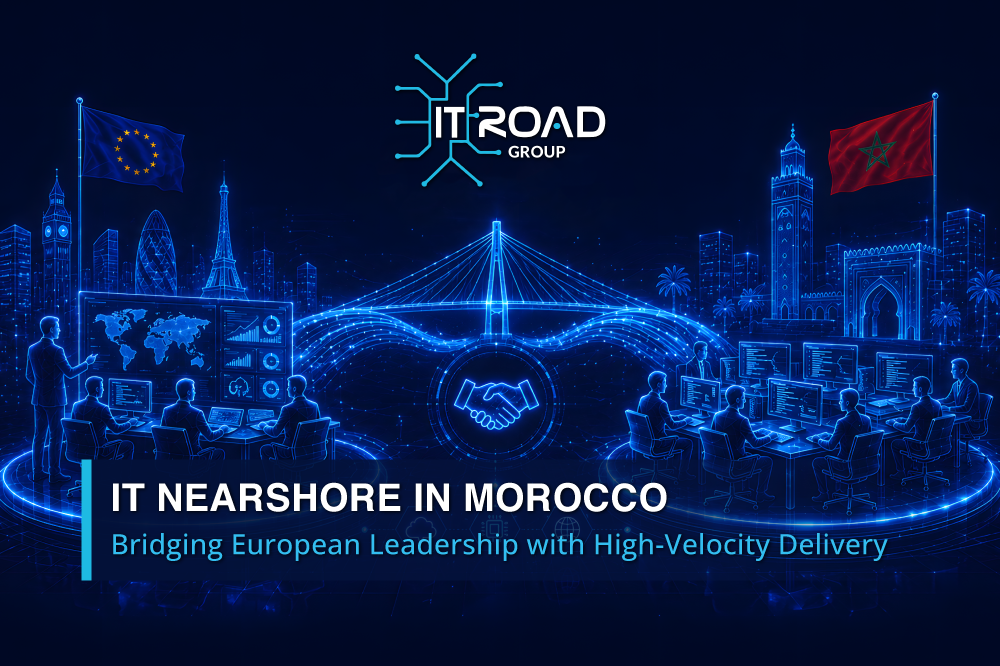
The European technology landscape is navigating a critical turning point. For Chief Information Officers (CIOs) and Chief Technology Officers (CTOs), the strategic question is no longer whether to externalize development capabilities, but rather which operating model guarantees sustained delivery velocity and architectural rigor without inflating fixed overhead or compromising quality.
Domestic recruitment across Europe remains constrained by intense talent scarcity and severe salary inflation. To overcome these roadblocks, leading European enterprises are turning toward Morocco as their strategic IT nearshore hub, powered by a pioneering operational framework: The Hybrid Nearshore Model.
The 4 Market Challenges Crippling Traditional IT Delivery
Simply adding headcount or outsourcing to unmanaged external providers no longer meets modern enterprise demands. Today’s technology leaders face four systemic bottlenecks that classic models fail to solve:
- High Costs and Salary Inflation: Escalating local hiring expenses and surging contractor day rates place immense pressure on annual IT budgets, forcing leaders to compromise on roadmap scope.
- Project Brakes and Innovation Bottlenecks: When strategic technical initiatives stall due to a lack of engineering capacity, time-to-market expands, causing enterprises to lose their competitive edge.
- Service Degradation and Operational Risk: Overstretched teams and disconnected developers struggle to maintain code standards, accumulating technical debt and compromising system reliability.
- Customer Dissatisfaction and Business Drift: Delivery delays and mismatched expectations inevitably impact end users, diverting executive attention away from core business growth.
The Breakdown of Traditional Distant Offshoring
For years, distant offshoring was treated as the default solution, driven purely by the search for the lowest possible hourly rate. However, field experience has demonstrated that the traditional “black box” approach—handing over a static specification sheet and hoping for production-ready code—has reached its absolute limits.
A significant time zone difference demands an exhausting level of asynchronous discipline. When developers sleep while European Product Owners validate sprints, precious business days are lost in transit. The lack of direct interaction fosters organizational silos, obscures visibility, and inevitably leads to costly rework and architectural misalignment.
Morocco: The Strategic IT Nearshoring Powerhouse for Europe
Morocco has established itself as Europe’s premier technology nearshore destination due to several structural and geographical advantages:
- Zero Time Zone Lag (GMT / GMT+1): Operating on the exact same business hours as the UK and Central Europe ensures real-time collaboration. Daily stand-ups, sprint reviews, architecture workshops, and emergency hotfixes happen synchronously without overnight delays.
- Elite Multilingual Talent: Morocco’s top engineering universities and technical institutions produce thousands of highly qualified software engineers, data specialists, and cloud architects annually, fluent in French, English, and Spanish.
- Cultural Affinity and Agile Maturity: Moroccan engineering squads share European corporate methodologies, working smoothly within modern Agile, Scrum, and DevOps frameworks with virtually zero cultural friction.
- Enterprise-Grade Infrastructure: Modern technopoles across Casablanca, Rabat, and Agadir provide high-speed subsea fiber connectivity to Europe, robust regulatory environments, and tier-level data centers.
The IT Road Group Solution: The Hybrid Nearshore Model
Geographical proximity alone does not guarantee project success; without rigorous steering, even nearshore initiatives can drift off course. To resolve this, IT Road Group has introduced the Hybrid Nearshore Model, positioning itself as a trusted partner for enterprise hybrid excellence.
At the core of this approach is a proprietary framework known as Dual-Steering Governance (Gouvernance Hybride à Double Pilotage). The model operates through two perfectly synchronized components:
1. Local Executive Steering (On-Premises in Europe)
Proximity is not just about geography; it is about collaboration, visibility, accountability, and execution. To guarantee this, an IT Road management, architecture, and steering team is physically embedded at the client’s site in Europe to ensure strategic alignment, proactive risk mitigation, and immediate decision-making.
This local leadership team becomes a natural extension of your organization. By maintaining a physical presence on your premises—anchored by our European headquarters in Paris—our consultants take a human-first approach, developing a deep understanding of your business objectives, corporate culture, and operational constraints before recommending a single solution.
Rather than treating technology as an isolated function, this on-site steering acts as the critical bridge between your grand business goals and your daily IT reality. It ensures that governance clears the road for execution, allowing for rapid decision-making and continuous strategic alignment, ensuring every IT investment directly drives your bottom line.
2. Nearshore Delivery Centers in Morocco
Behind this local European leadership, the team seamlessly coordinates our high-performance Nearshore Delivery Centers in Morocco. Working in the exact same time zone means your daily stand-ups, sprint planning, issue resolution, and project collaboration all happen in real time with absolutely zero communication delays. You get the strategic proximity and control of an in-house team, combined with the scalability, speed, and cost-efficiency of a world-class nearshore delivery center.
The 5 Pillars of the IT Road Digital Factory
Through this Dual-Steering Governance, IT Road Group builds, deploys, and manages dedicated Digital Factories tailored to enterprise needs across five strategic pillars:
- Software Engineering: End-to-end full-stack software development, modern microservices architecture, API integrations, and legacy code modernization engineered for Agile velocity.
- Cloud & Infrastructure: Cloud-native migrations, sovereign infrastructure deployment, and DevOps automation powered by strategic technology partnerships.
- Data & AI: Enterprise data architecture, logical data virtualization, master data governance, and production-ready generative AI workflows that transform disparate data silos into strategic business assets.
- Cybersecurity: Zero-trust architecture implementation, security audits, threat monitoring, and regulatory compliance alignment to protect your most critical assets.
- QA & Test Automation: Industrialized automated testing frameworks, regression pipelines, and continuous quality monitoring to ensure secure, zero-defect production releases.
Talent Readiness: The ITROAD Academy Advantage
A high-performance nearshore model requires a sustainable talent pipeline. Rather than relying solely on open-market hiring, IT Road Group actively prepares its engineering squads through ITROAD Academy.
- Real-World Enterprise Scenarios: Candidates are trained on actual, complex business use cases, navigating architectural challenges and deployment schedules they will face on live client projects.
- Direct Mentorship by Senior Architects: Top Enterprise Architects and Tech Leads mentor engineering squads in coding standards, zero-trust security practices, and Agile delivery.
- Mastery of the Modern Stack: Dedicated tracks ensure engineers master production stacks and enterprise tools, including generative AI APIs, cloud infrastructures, and data virtualization.
- Soft Skills and Cultural Alignment: Engineers are trained in proactive cross-border communication and remote collaboration, ensuring smooth integration with European stakeholders from day one.
Frequently Asked Questions
Why is Morocco considered an ideal IT nearshore destination for European businesses?
Morocco combines full time zone alignment (GMT/GMT+1) with Europe, a large pool of multilingual engineering talent, modern digital infrastructure, and competitive operating costs. This enables real-time collaboration with European development squads without the communication delays and cultural friction associated with distant offshore setups.
What makes the IT Road Group Hybrid Nearshore Model unique? Unlike traditional outsourcing providers that merely delegate remote profiles, IT Road Group implements a Dual-Steering Governance structure. An on-site executive leadership team is embedded directly at the client’s premises in Europe to ensure strategic alignment, while dedicated nearshore engineering teams in Morocco execute production with real-time responsiveness.
How does Dual-Steering Governance eliminate project risks? By placing management and architectural oversight directly with your local teams, IT Road Group ensures that daily development remains completely aligned with business priorities, architectural standards, and sprint timelines. This eliminates the “black box” risk of unmanaged outsourcing and guarantees continuous visibility.
Which technology domains are covered by IT Road Group’s Digital Factory? IT Road Group builds dedicated Digital Factories across five strategic pillars: Software Engineering, Cloud & Infrastructure, Data & AI, Cybersecurity, and QA & Test Automation.
Accelerate Your IT Roadmap with Complete Visibility
Overcoming IT talent shortages and budget pressures does not require sacrificing delivery control or software quality. Backed by a 360° consulting approach and operations across France, Morocco, Tunisia, and the UAE, IT Road Group transforms externalized engineering into a sustainable performance engine.
Ready to scale your software engineering capabilities with a trusted delivery partner?
Explore our solutions and schedule an executive strategy session at itroadgroup.com to map out your company’s digital future.