

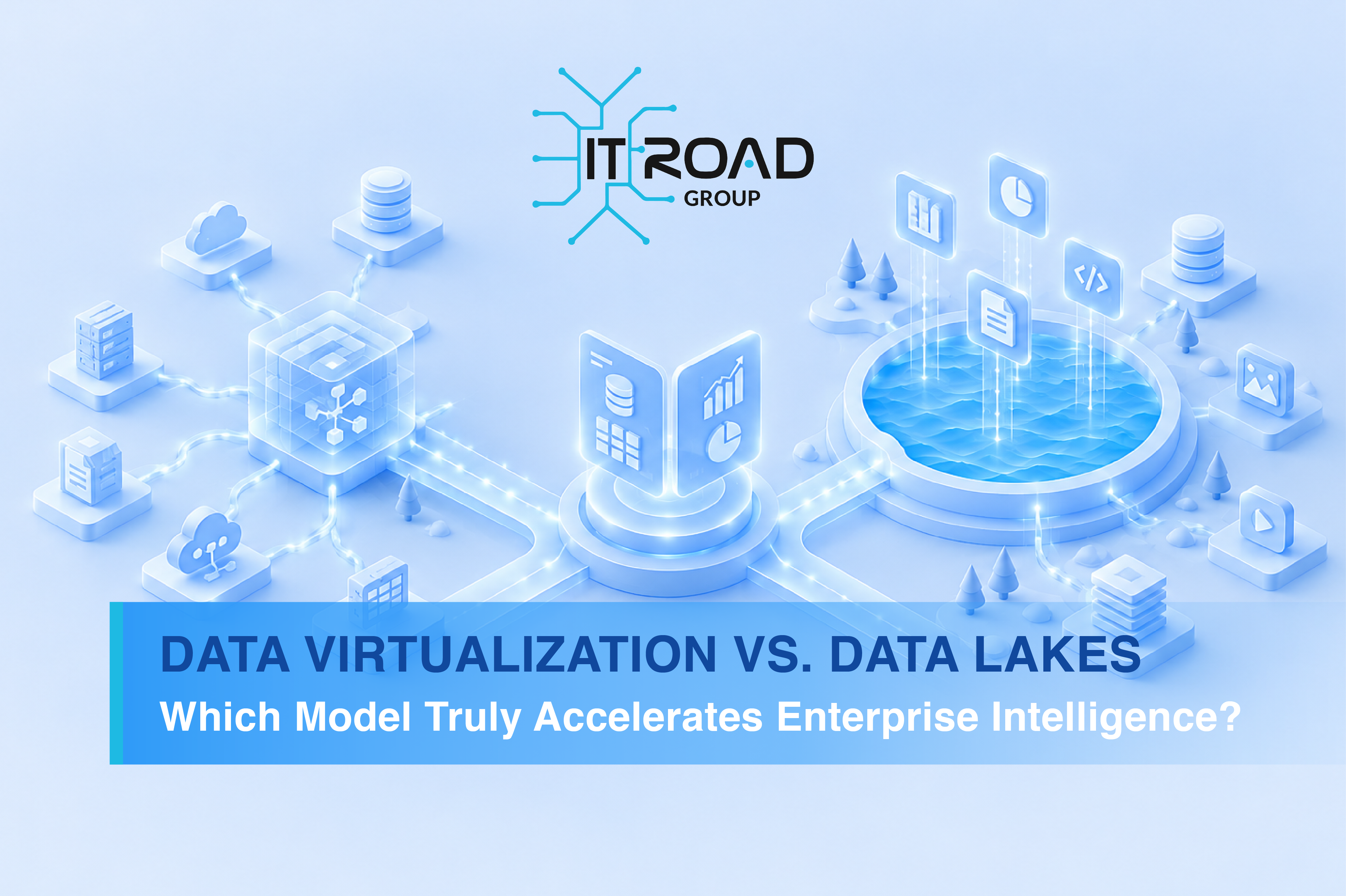
In the race to build an agile, data-driven organization, executive leadership faces an inescapable structural crossroad. Enterprise data architecture is never neutral: it functions either as an asset that accelerates growth, or as an operational liability that holds back strategic execution.
For the past decade, enterprise IT strategies defaulted to the Data Lake. Organizations collected petabytes of raw, unstructured data into massive centralized repositories under the assumption that physical centralization was the prerequisite for insight. However, modern business velocity demands instant operational intelligence rather than multi-year storage consolidations. As a result, forward-thinking CIOs and enterprise architects are shifting their focus toward Data Virtualization. Determining which model truly accelerates enterprise intelligence requires a clear comparison between physical data centralization and real-time logical abstraction.
The Data Lake: The Physical Consolidation Approach
A Data Lake operates as a centralized physical storage repository designed to store structured, semi-structured, and unstructured raw data in its native format. It decouples storage from compute, allowing organizations to ingest large volumes of information without immediately applying a rigid database schema.
Enterprises traditionally deploy Data Lakes to satisfy distinct long-term data requirements:
- Massive Long-Term Storage: Data Lakes handle vast streams of unrefined telemetry, server event logs, and unstructured multi-format data at an economical infrastructure cost.
- Exploratory Data Science: Because Data Lakes support schema-on-read mechanics, machine learning specialists and data scientists can interrogate raw information and build deep training pipelines on demand.
- Centralized Historical Archives: They provide an enduring historical baseline for enterprise reporting, forensic auditing, and long-range retrospective analysis.
Despite these capabilities, relying exclusively on a Data Lake to power executive intelligence introduces significant operational bottlenecks:
- The Ingestion Pipeline Trap: Moving data physically into a lake requires designing, deploying, and maintaining fragile Extract, Transform, and Load (ETL) or ELT pipelines. These pipelines often demand months of engineering effort and break whenever upstream source schemas change.
- Time-to-Value Latency: Because raw data must be staged, cleaned, and transformed into downstream analytical layers before business analysts can consume it, decision-makers face persistent delays when requesting new insights.
- The Proliferation of Data Swamps: Without ironclad, automated metadata indexing and enterprise governance, Data Lakes rapidly degrade into disorganized data swamps where business teams cannot locate, trust, or validate core information.
Data Virtualization: The Logical Abstraction Model
Data Virtualization takes the opposite architectural approach. Instead of treating data integration as a physical transport problem, it solves integration through a high-performance logical abstraction layer positioned directly above existing corporate systems.
By querying distributed data directly where it lives, Data Virtualization establishes an agile foundation for enterprise intelligence:
- Zero Data Displacement: Information remains secured within its operational systems of record, completely eliminating unnecessary data duplication, cross-network data transfer fees, and synchronization latency.
- Real-Time Data Federation: The virtualization engine interprets complex analytical queries, distributes the compute instructions across heterogeneous data sources simultaneously, and synthesizes the results instantly into a single view.
- Unified Access and Governance: A single logical gateway standardizes access control policies, role-based data masking, and audit logging across on-premise relational databases, cloud applications, and existing warehouses.
Structural Breakdown: Physical Movement vs. Logical Abstraction
Evaluating Data Virtualization and Data Lakes reveals distinct structural differences across every core operational metric:
- Data Movement and Footprint: Data Lakes mandate continuous, batch-oriented data copies that increase storage footprint and data redundancy. Data Virtualization leaves source data untouched, executing distributed queries directly against live systems without moving underlying records.
- Speed of Implementation: Implementing physical data lake pipelines typically requires multi-quarter engineering roadmaps to design schemas, validate ingest workflows, and rebuild broken feeds. In contrast, Data Virtualization deploys virtual views within hours or days, allowing business teams to experiment with new data combinations immediately.
- Information Freshness: Data Lakes inherently present a latent snapshot of enterprise activity based on the frequency of batch processing windows. Data Virtualization retrieves the latest transactional state at the exact moment a query executes, supplying real-time intelligence for operational decision-makers.
- Governance and Security Overhead: In a Data Lake architecture, security teams must duplicate access permissions, encryption policies, and compliance guardrails across both the source systems and the target storage buckets. Data Virtualization consolidates policy enforcement into a single logical enforcement point across all downstream consumption tools.
- Core Architectural Purpose: Data Lakes excel as heavy analytical playgrounds for unstructured data exploration, machine learning model training, and cold archiving. Data Virtualization serves as the real-time operational backbone for executive cockpits, cross-functional reporting, and customer-facing data services.
The Strategic Verdict: Which Model Drives Velocity?
Both architectural paradigms serve legitimate enterprise functions, but they address entirely different operational priorities.
If the organization’s primary objective is accumulating petabytes of raw, multi-format sensor logs and training deep learning algorithms on years of historical unstructured records, a Data Lake remains a necessary asset.
However, if executive leadership needs immediate, accurate intelligence across fragmented operational silos—such as unifying ERP, CRM, and financial accounting data for agile executive dashboards—Data Virtualization is the definitive accelerator. Attempting to solve everyday reporting fragmentation by physically transferring every operational database into a centralized lake introduces latency, inflates cloud infrastructure spending, and stalls digital execution. Data Virtualization establishes a single, governed point of truth immediately, enabling confident decision-making without organizational friction.
How IT Road Group Engineers Your High-Velocity Blueprint
At IT Road Group, we recognize that sustainable digital transformation begins with a rigorous structural blueprint. Advanced software solutions should never be implemented in an architectural vacuum.
Through our 360° Architecture & Data Management practice, our consultants collaborate directly with executive leadership to deconstruct legacy silos, modernize enterprise workflows, and design scalable blueprints tailored to high-growth environments. To combine analytical speed with enterprise-grade security, we build modern logical data platforms alongside our strategic partner Denodo, the recognized global leader in data virtualization.
Working alongside Denodo, we unlock the full strategic value of your information ecosystem:
- We eliminate high-risk, multi-year physical data migration projects that disrupt active operations.
- We establish a resilient logical gateway that unifies on-premise infrastructure with hybrid, multi-cloud platforms.
- We guarantee end-to-end regulatory compliance under both international governance standards and Morocco’s CNDP Law 09-08.
We transform your operational data complexity into a unified, high-performance decision engine.
FAQ Section
What is the difference between a Data Lake and Data Virtualization?
A Data Lake physically extracts, copies, and consolidates raw information into a central storage repository for subsequent processing. Data Virtualization queries existing operational databases directly where they reside, creating a real-time logical abstraction layer without moving the underlying records.
Can Data Virtualization work alongside an existing Data Lake?
Yes. Data Virtualization frequently connects to an existing Data Lake as one of many query endpoints. It exposes the curated layers of the lake alongside ERPs, relational databases, and third-party SaaS tools through a single federated gateway.
Why does Data Virtualization deliver faster time-to-value than traditional ETL?
Traditional ETL processes require extensive data modeling, complex pipeline construction, and ongoing maintenance to manage pipeline breakage. Data Virtualization connects directly to source data schemas and deploys virtualized business views in days instead of months.
How does Denodo enable modern logical data architectures?
Denodo provides an enterprise-grade logical data platform equipped with dynamic query optimization, parallel execution, smart caching mechanisms, and unified data cataloging. IT Road Group implements Denodo to federate distributed corporate information without the overhead of physical consolidation.
How does Morocco’s CNDP Law 09-08 affect data storage architectures?
Law 09-08 enforces strict statutory requirements governing the collection, processing, and cross-border transfer of personal data. Because Data Virtualization queries operational data in place rather than creating redundant physical copies across disparate cloud storage buckets, it substantially reduces regulatory exposure and simplifies data governance compliance.