

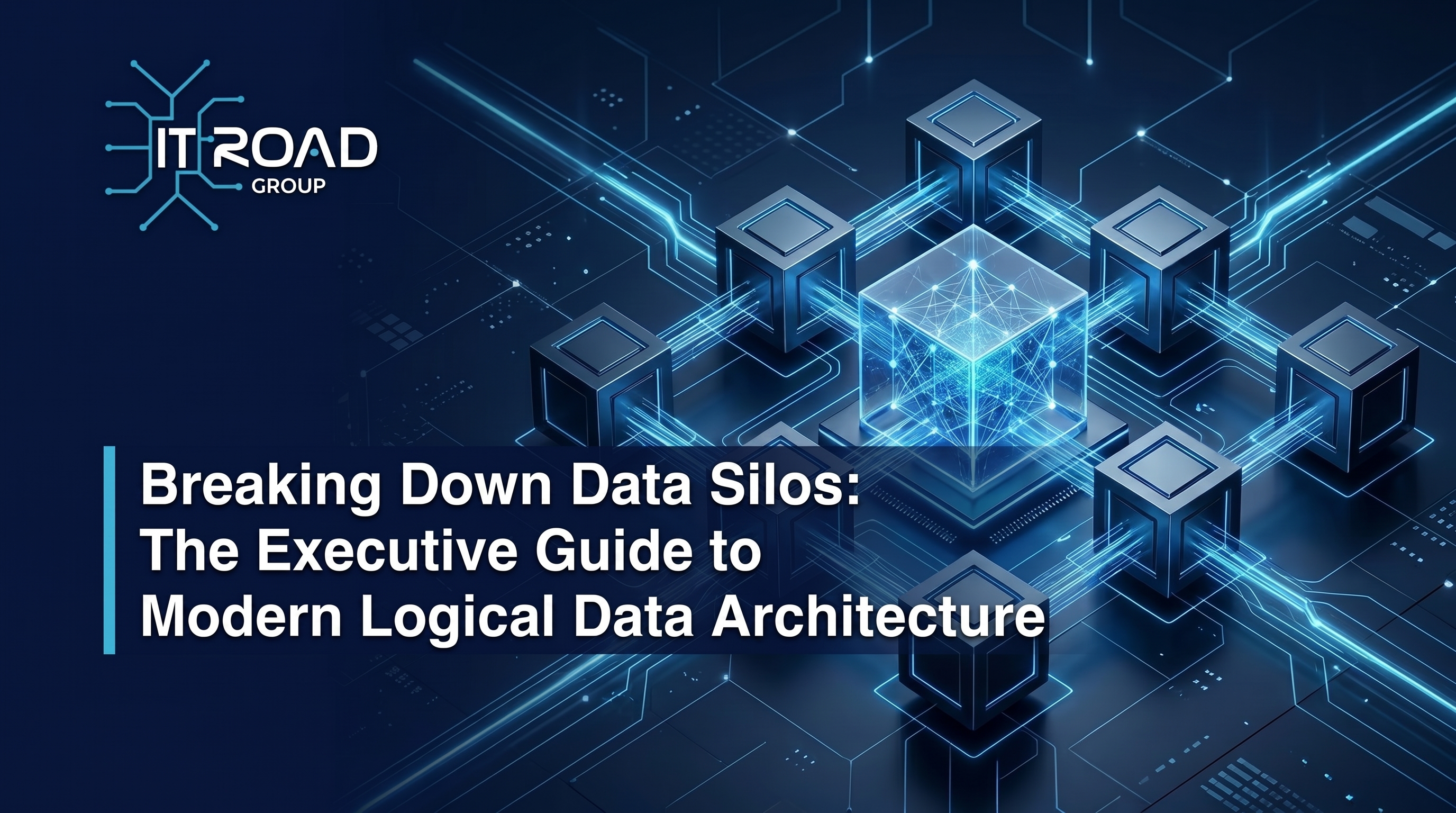
The Data Paradox of the Modern Enterprise
In large organizations, executive leadership rarely suffers from a lack of data. Instead, they suffer from data fragmentation.
Every day, millions of data points are generated across Finance, Marketing, HR, and Operations. Yet when a CEO or CIO needs a single, accurate view of corporate performance to make a critical strategic decision, they are met with a familiar frustration: conflicting reports, missing context, and weeks of manual data consolidation.
This is the data silo problem. It turns an organization’s most valuable asset — its data — into a bottleneck that stalls agility and blocks growth.
Traditional approaches to fixing this issue involve multi-year, high-risk physical data migration projects. But in today’s fast-moving market, there is a more efficient, modern alternative.
The Hidden Toll of Siloed Architecture
Data silos are not just a technical inconvenience; they are a direct threat to business execution. When departments operate on isolated legacy platforms, the consequences ripple across the entire organization:
Paralyzed Decision-Making: When different business units present conflicting figures for the same metric, leadership loses trust in the data and reverts to instinct-driven choices — a dangerous position in competitive markets.
Operational Inefficiencies: Industry research consistently shows that data teams spend the majority of their time finding, cleaning, and blending data from disparate systems, rather than generating actionable insights. The actual analysis — the work that drives decisions — becomes the afterthought.
Stalled AI and Innovation: Modern AI and predictive analytics engines require clean, integrated, cross-departmental data. A fragmented data architecture doesn’t just slow AI adoption — it causes AI initiatives to produce unreliable outputs, since model accuracy is only as good as the data it is trained and fed on.
The Migration Trap: Why “Rip-and-Replace” Fails
For years, the standard corporate playbook for data fragmentation was straightforward: physically consolidate all data into a single, centralized data warehouse. One system. One truth.
In theory, it works. In practice, for large enterprises with deeply entrenched legacy infrastructure, this approach frequently becomes a migration trap:
High Failure Rates and Cost Overruns: Large-scale physical data migrations are notorious for exceeding budgets and timelines, often by significant margins. The complexity of mapping, transforming, and validating data from dozens of source systems is routinely underestimated at the outset.
Operational Disruption: Moving live production data risks disrupting daily business operations and client-facing services — exposing the organization to continuity risk precisely during the migration window.
Instant Obsolescence: By the time a multi-year physical consolidation project completes, the company’s data needs and source systems have already evolved. The destination architecture may already require redesign.
The result: enterprises invest years and significant capital into a migration project, only to find themselves operating a newer version of the same fundamental problem.
The Solution: Unifying Access with Logical Data Architecture
To break down silos without the risk of physical displacement, forward-thinking CIOs are shifting their approach — from moving data to connecting it.
A Logical Data Architecture is a design strategy that treats data as a unified, governed resource regardless of where it physically lives. Rather than physically consolidating data into a new repository, it establishes a managed abstraction layer that sits above all existing source systems.
The most common technical implementation of this strategy is Data Virtualization: a platform that serves as a single, central gateway directly above your backend infrastructure. By connecting and federating live, simultaneous queries across entirely different environments—such as Finance ERPs, HR platforms, Marketing clouds, cloud repositories, and legacy on-premise warehouses—it instantly delivers real-time information as if it came from one unified source.
This structural shift delivers three significant advantages for large organizations:
1. Zero Data Displacement
Data stays exactly where it belongs — securely inside the source systems managed by each respective department. The virtualization layer queries source systems in real time when an insight is needed, eliminating the cost, risk, and latency of physical duplication.
2. Faster Time-to-Value
Because you are building a virtual integration layer rather than rewriting physical databases, enterprise integration timelines drop dramatically. Leadership can gain access to consolidated, cross-departmental dashboards in months rather than years — without disrupting live operations.
3. Governed Security at Scale
Managing access rights across dozens of different applications is a governance and compliance challenge. A logical data platform centralizes that governance, allowing IT and security leaders to enforce access controls, apply data masking, and maintain audit trails from a single command center — regardless of where the underlying data resides.
Aligning Technology with Ambition
Data fragmentation is an architectural problem, but solving it is a strategic decision.
The organizations that move fastest are not the ones with the most data — they are the ones whose leaders can access the right data, at the right level of granularity, at the exact moment a decision needs to be made. Logical Data Architecture makes that possible without forcing a choice between transformation speed and operational stability.
Breaking down silos is, ultimately, about transforming data from a collection of isolated departmental properties into a synchronized corporate intelligence engine.
At IT Road Group, our 360° consulting methodology aligns your technology architecture with your business ambitions. If your organization is evaluating the readiness of its current infrastructure for a modern data platform, our advisory team is available to assess where you stand and what a practical path forward looks like.
[Explore our Enterprise Architecture and Data Management solutions →]